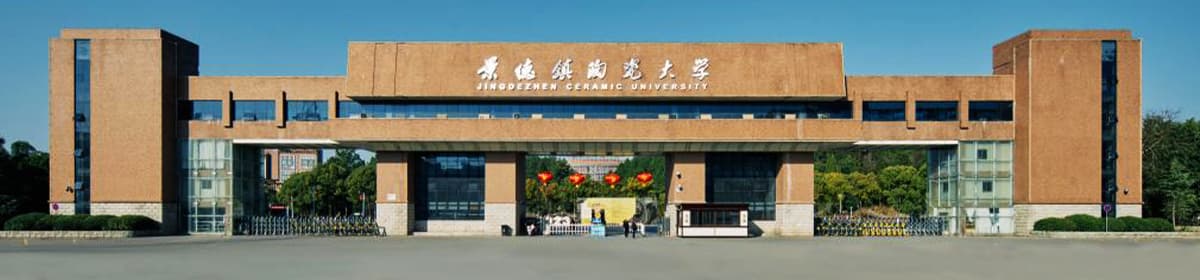
Jingdezhen Ceramic University
Jingdezhen Ceramic University, as the only multi-disciplinary university whose talents cultivation level includes undergraduates, graduates and PhDs in the world with ceramics as its symbol and ceramics as its main discipline, is one of the first 31 independently-set up undergraduate art universities in China, one of the 94 eligible colleges and universities enrolling international students entitled to the Chinese government’s scholarship in China.
Jingdezhen Ceramic University is located in the first batch of national historical and cultural city in Jiangxi province. Now there are Xianghu Campus, Xinchang Campus, China Light Industry Ceramics Research Institute and Sanbao Ceramics Research and Training Garden, covering an area of 2265 mu, with a building area of nearly 750,000 square meters. There are 11 teaching schools (departments), including School of Materials Science and Engineering, School of Ceramic Art, School of Design and Art, School of Mechanical and Electronic Engineering, School of Management and Economics, School of Information and Engineering, School of International Studies, Art and Archaeology School, School of Marxism, Law School, Sports and Military Education Department. Besides there are Graduate School,School of Chuangye, School of Continuing Education and College of International Education. There are more than 20,000 full-time students, including nearly 2,000 postgraduates and doctoral students.
Disciplines and Specialties: The school adheres to the principle of ceramics, pays attention to the integration of art and industry, highlights the advantages of design art and ceramic engineering, and constantly optimizes and adjusts the structure of discipline and specialty layout. The school has three first-class doctoral disciplines, namely Art Design, Material Science and Engineering, Science and Technology History, 13 first-class master disciplines in Management Science and Engineering, Mechanical Engineering and 8 professional master’s degree programs including Cultural Relics and Archaeology and MTI. Among them, 3 disciplines including Art Design, Material Science and Engineering and Fine Arts are provincial first-class disciplines. Art Design is the leading discipline in Discipline Alliance for the Jiangxi Province colleges and universities. Now JCU has 59 undergraduate majors, covering such disciplines as engineering, art, management, literature, science and history. JCU cultivates high level talents of the whole industry chain from ceramic materials, design, manufacture to management. Among them, there are 9 national first-class undergraduate professional construction points, 14 Provincial first-class undergraduate specialty construction points, 3 outstanding specialties with national characteristic, 3 national pilot specialties for Excellent Engineers Training Program, 1 national comprehensive reform pilot project, 1 Industry-university Cooperative Specialty Comprehensive Reform Project of the Ministry of Education. Such majors as fine arts and design are in advance batch of undergraduate enrollment in Jiangxi province. 14 majors of science and engineering, literature and history are the first batch of undergraduate enrollment in Jiangxi Province.
Faculty: The university now has 946 full-time teachers among them 517 associate professors and professors, including 2 young and middle-aged experts with outstanding national contributions, 1 expert from the Subject Assessment Group of the Academic Degrees Committee of The State Council, 4 selected candidates by the New Century Excellent Talents Support Program of the Ministry of Education, and 3 candidates selected by the New Century Million Talents Project at the national level, 41 at the provincial level. 26 experts are entitled to special government allowance from The State Council. 10 experts are entitled to special government allowance from the provincial government. There are 3 specially-hired professors of Jinggang Scholars, 11 candidates of Jiangxi Outstanding Talents 555 Project, 25 Chinese Ceramic Art Masters, and more than 200 high-level talents at or above the provincial level, including members of the Teaching Steering Committee of the Ministry of Education, the Provincial Outstanding Contribution Talents, the Provincial Middle-aged and Young Cultural Masters, and the Provincial Double Thousand Program.
Talent Cultivation: JCU fully implements the party’s education policy and the fundamental task of morality education, unceasingly strengthening the educational philosophy of student-center, knowledge-output and continuous improvement. It meticulously forges JCU’s pattern of “Three-wide Education” and further deepens “Three Creative Talent Training Mode” reform. All these practices will markedly enhance its capability of personnel training. The undergraduate teaching assessment expert group of the Ministry of Education gives its evaluation of JCU as “Forming its unique thinking and important experience which can stay ahead and set a good example in similar colleges with industrial features”. In recent years, students have made great achievements in all kinds of extracurricular scientific and technological innovation competitions, and have won more than 600 national and provincial awards successively, including one Grand Prize of Challenge Cup in National College Students Extracurricular Academic Science and Technology Works Competition, one Gold Prize of National Internet+ College Students Innovation and Entrepreneurship Competition, and Grand Prize of China Engineering Robot Competition, First Prize of National Mathematical Contest in Modeling, First Prize of National College Students Mechanical Innovation Design Competition. A large number of students’ art works are selected in the national art exhibition. More than 35% of the graduates choose employment and entrepreneurship in Jiangxi Province, and about 30% of the graduates choose employment and entrepreneurship in the ceramic industry, which provides a strong talent support for promoting regional economic and social development and the development of the ceramic industry.
Scientific Research: JCU has been dedicated to the innovation research in ceramic materials, manufacture and equipment technology. It has provincial and ministerial scientific research centers such as National Engineering Research Center for Domestic and Building Ceramics (the first one in Jiangxi). There are two state-level scientific and technological innovation platforms such as the National and Local Joint Engineering Research Center for New Ceramic Materials, and 38 provincial and ministerial level scientific and technological innovation platforms such as China Light Industry Ceramics Research Institute, the National Ceramic Product Quality Supervision and Inspection Center. The Ceramic Branch of China Ceramic and Silicate Society and a number of national professional associations and institutions are residing in the school, forming comprehensive service, leading the development of the ceramic industry and constructing a complete scientific and technological support system. In recent years, the university has undertaken 194 national scientific research projects and 1047 provincial and ministerial scientific research projects, most of which focus on the key technology in the field of traditional and high-tech ceramic industry, which honorably won 89 provincial and ministerial awards. There are one First Prize, two Second Prizes and two Third Prizes of Jiangxi provincial technology progress. There are also two Second Prizes and three Third Prizes of Jiangxi provincial natural science, one Third Prize of Jiangxi provincial technological invention, four First Prizes of Jiangxi provincial social science outstanding achievement.
International Exchange: The university gives full play to its unique disciplinary advantages and consciously acts as the ambassador of traditional Chinese culture. As one of the 60 most distinctive universities in China, it participated in the Exhibition of 21st Century Chinese Universities organized by the Ministry of Education in Russia and held a high level of teachers’ and students’ ceramic art exhibition, representing China in such important places as the Louvre Museum in France, the Asian Museum in Greece, the Grand Palais in France and the United Nations headquarters in New York. In this way JCU spreads the broad and profound Chinese ceramic culture and art to all over the world. In recent years, the school has successively established friendly relations of cooperation with International Ceramic Artists Association and more than 30 colleges and universities in such countries or regions as America, Britain, France, Japan and South Korea. It hosted more than 10 international academic seminars (forums) on ceramic engineering, ceramic art, ceramic culture and ceramic education. We will carefully build the high-end academic brand of Jingdezhen International Ceramic Art Biennale, tell good ceramic stories and spread the voice of China. In 1958, the school began to accept foreign students, and has trained more than 3,000 international students from nearly 60 countries and regions on all continents. JCU has been successfully approved as the Sino-Foreign Humanity Exchange Training Base in the field of Intelligent Manufacturing by the Ministry of Education, and has been selected as the governing unit of the China-Europe Alliance for Humanities and Arts Education. The JCI-WVU International Ceramic Artist Studio project was listed as “a model and new climax of Sino-US people-to-people exchanges” in 200 Years of Sino-US Relations published by the US State Department.
Jingdezhen Ceramic University gives full play to its unique disciplinary advantages and consciously acts as the ambassador of traditional Chinese culture. As one of the 60 most distinctive universities in China, it participated in the Exhibition of 21st Century Chinese Universities organized by the Ministry of Education in Russia and held a high level of teachers’ and students’ ceramic art exhibition, representing China in such important places as the Louvre Museum in France, the Asian Museum in Greece, the Grand Palais in France and the United Nations headquarters in New York. In this way JCU spreads the broad and profound Chinese ceramic culture and art to all over the world. In recent years, the school has successively established friendly relations of cooperation with International Ceramic Artists Association and more than 30 colleges and universities in such countries or regions as America, Britain, France, Japan and South Korea. It hosted more than 10 international academic seminars (forums) on ceramic engineering, ceramic art, ceramic culture and ceramic education. We will carefully build the high-end academic brand of Jingdezhen International Ceramic Art Biennale, tell good ceramic stories and spread the voice of China. In 1958, the school began to accept foreign students, and has trained more than 3,000 international students from nearly 60 countries and regions on all continents. JCU has been successfully approved as the Sino-Foreign Humanity Exchange Training Base in the field of Intelligent Manufacturing by the Ministry of Education, and has been selected as the governing unit of the China-Europe Alliance for Humanities and Arts Education. The JCI-WVU International Ceramic Artist Studio project was listed as “a model and new climax of Sino-US people-to-people exchanges” in 200 Years of Sino-US Relations published by the US State Department.